


Anamorphic Display: The Revolution of OOH Advertising in Indonesia
Sunday, 8 Dec 2024

PT Lestari Dev Solusindo
Aldeoz Building Lt. 6, Jl. Wr. Jati Barat No.39, RT.2/RW.4, Kalibata, Pancoran, Jakarta Selatan, DKI Jakarta, 12740.
+6281389455717 - contact@lestariads.com
www.lestariads.com

Indonesia is one of the world's largest countries by population, with a rapidly growing middle class and an increasingly sophisticated consumer market. Jakarta, as the nation's capital, serves as the center of business, government, media, and lifestyle trends that influence the rest of the country.
For international companies looking to enter the Indonesian market, Jakarta Car Free Day provides a unique opportunity to understand consumer behavior directly.
Instead of relying only on market research reports or demographic data, brands can observe how people interact, communicate, and respond to campaigns in a real public environment.
Many global companies use these types of offline experiences to test marketing messages, introduce new products, gather customer feedback, and build awareness before launching larger campaigns.
People who visit Jakarta Car Free Day are generally interested in active lifestyles, health, sustainability, communities, and new experiences.
This makes Car Free Day highly relevant for various industries, including:
However, this does not mean other industries cannot benefit from Car Free Day.
The key is how a brand connects its product or service with the activities and interests of the audience.
For example, logistics companies can highlight low emission delivery solutions. Energy companies can educate the public about clean energy adoption. Even B2B companies can strengthen their corporate reputation through relevant sustainability campaigns.
The most successful campaigns are those that become part of the audience's experience rather than simply delivering a promotional message.
Not every campaign successfully captures public attention.
In many cases, the problem is not the location, but the strategy.
1. Focusing Too Much on Selling Products
Car Free Day is not a shopping mall.
Visitors come to enjoy the atmosphere, exercise, socialize, and spend quality time outdoors.
Brands that aggressively push sales messages often receive less engagement compared to brands that create meaningful experiences.
Instead of asking:
"How can we sell our product today?"
Brands should ask:
"How can we create value for visitors today?"
This simple change in mindset can significantly improve campaign effectiveness.
2. Creating No Interactive Experience
A booth containing only banners, brochures, and promotional materials can easily be ignored.
Simple interactive activities such as games, challenges, demonstrations, or educational experiences can dramatically increase engagement.
Examples include:
The more involved people become, the stronger the connection with the brand.
3. Ignoring Social Media Potential
Today, almost every visitor carries a smartphone.
If a campaign does not have something visually interesting or shareable, brands miss a major opportunity for organic digital exposure.
A successful Car Free Day campaign should consider:
A single visitor sharing a meaningful experience can extend a campaign's reach far beyond the physical location.
4. Not Collaborating with Communities
Communities are one of the biggest strengths of Car Free Day.
Collaboration with cycling groups, running communities, photography groups, environmental organizations, or lifestyle communities can create stronger engagement compared to running a campaign independently.
Communities already have trust and influence among their members.
When a brand becomes part of that community, communication feels more authentic.
5. Using Media That Lacks Flexibility
Static promotional media has limitations because it cannot follow audience movement.
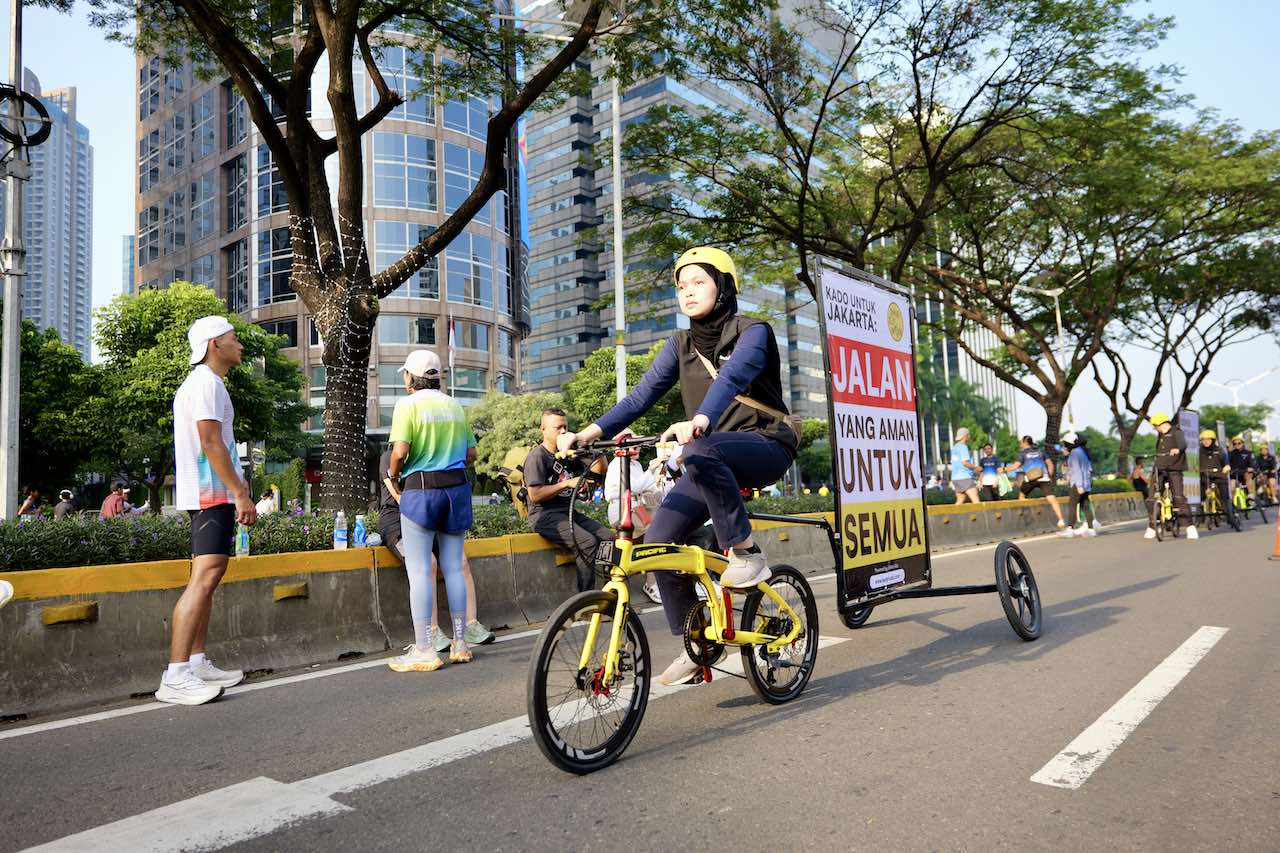
Mobile media solutions, such as bike billboards, allow campaigns to move through different areas where visitor concentration is highest.
This flexibility helps brands maximize visibility throughout the event.
A successful Car Free Day campaign does not always depend on having a large budget.
Often, a simple but relevant idea can create a stronger impact than an expensive campaign without a clear purpose.
The following principles can help brands maximize their results.
People remember experiences more easily than slogans.
Brands should think about how they can help, entertain, educate, or inspire visitors.
A positive experience creates emotional connections.
The stronger the emotional connection, the higher the chance people will remember and share the brand.
For example:
A beverage company can create a hydration station for runners.
A sports brand can organize a warm up session.
A technology company can create an interactive digital challenge.
An environmental organization can organize a sustainability themed cycling activity.
The brand becomes part of the experience rather than an interruption.
Complex messages are difficult to absorb when people are moving through public spaces.
Outdoor advertising works best when the message is:
One powerful message is usually more effective than multiple messages competing for attention.
A strong campaign should answer one simple question:
"What should people remember after seeing this?"
Do not simply wait for visitors to come.
Use communication channels that can move closer to the audience.
Bike billboards, promotional teams, and community activities allow campaigns to reach more people without requiring visitors to enter a specific activation area.
This is especially valuable in large public spaces where audience movement changes throughout the day.
Every physical activation should have a digital continuation.
Examples include:
This approach extends campaign lifespan even after Car Free Day ends.
A successful offline experience can become a continuous digital conversation.
In recent years, more companies have committed to Environmental, Social, and Governance (ESG) principles.
These commitments are no longer communicated only through annual reports.
Brands increasingly need to demonstrate sustainability through visible actions.
Car Free Day provides an ideal environment for sustainability messaging.
Examples include:
When the communication method matches the message, audiences are more likely to trust the brand's commitment.
For example, a sustainability campaign promoted through a traditional high emission vehicle may create a weaker message compared to a campaign using bicycles or human powered mobility.
The medium itself becomes part of the story.
Campaign performance should not only be measured by the number of people who see the advertisement.
Brands should evaluate multiple indicators.
| Metric | Purpose |
|---|---|
| Number of interactions | Measure direct audience engagement |
| Visitor photos and videos | Measure visual appeal |
| Social media posts | Measure organic reach |
| Hashtag usage | Measure public participation |
| Website visits | Measure continued interest |
| QR code scans | Connect offline and online activities |
| Leads generated | Measure business potential |
| Media coverage | Measure public awareness |
By combining these measurements, brands can gain a clearer understanding of campaign effectiveness.
Technology will continue changing how brands communicate with consumers.
However, one thing will remain constant.
People value real human experiences.
As digital advertising becomes more competitive, online attention becomes more expensive, and consumers become more selective, direct human interaction becomes increasingly valuable.
Car Free Day provides something digital platforms cannot fully replicate:
A genuine connection between brands and people.
Not simply seeing an advertisement, but experiencing it, feeling it, and remembering it.
This is why more companies are combining:
into one integrated marketing strategy.
Jakarta Car Free Day is not simply a weekly event where roads are closed to vehicles.
It has evolved into one of Indonesia's most dynamic public spaces, where people gather, interact, and create shared experiences.
For brands, this creates a valuable opportunity to connect with audiences in a more relaxed, open, and engaging environment.
The success of a Car Free Day campaign does not depend only on logo size or advertising budget.
It depends on a brand's ability to create an experience that is relevant, valuable, and worth sharing.
Media solutions such as bike billboards, community activations, and sustainable campaigns allow companies to not only increase visibility but also build stronger relationships with their audiences.
In an era where consumer attention is becoming increasingly expensive, Jakarta Car Free Day proves that real world experiences remain one of the most powerful forms of marketing communication.

Sunday, 8 Dec 2024
Friday, 25 Apr 2025

Tuesday, 12 Nov 2024
Thursday, 31 Oct 2024

Saturday, 9 Nov 2024

Lestari Ads Agency - PT Lestari Dev Solusindo
Lestari Ads is a leading out-of-home media company with the largest network in Indonesia. We believe the world is a canvas. Every advertisement is an opportunity to inspire, engage, and transform public spaces. We continuously push boundaries in Out-Of-Home (OOH) advertising, changing the way brands interact with audiences beyond the digital screen, bringing stories to life where people live, move, and connect.
The most trusted OOH advertising agency in Indonesia
Experience the top of visibility with Indonesia's leading out-of-home (OOH) advertising agency. We specialize in turning the urban landscape into a dynamic canvas for your brand, crafting compelling narratives that capture the imagination of millions. Our mastery over strategic placements and innovative formats ensures your message not only reaches, but resonates with a diverse and expansive audience. With a proven track record of delivering high-impact campaigns across Indonesia's bustling cities and beyond, we redefine what's possible in OOH advertising.
Find the best quality billboard advertising space with variety of size and dimension
out-of-home advertising, digital billboards, traditional billboards, transit advertising, street furniture advertising, outdoor signage, digital ooh, led billboards, static billboards, large format advertising, advertising displays, ooh media, advertising billboards, outdoor digital screens, urban advertising, roadside billboards, digital signage, retail advertising, poster advertising, mobile billboard advertising, digital transit ads, interactive ooh, airport advertising, mall advertising, cinema advertising, sports venue advertising, digital outdoor advertising, public transportation ads, taxi advertising, bus shelter ads, pedestrian advertising, advertising kiosks, outdoor media solutions, billboard marketing, ooh advertising strategies, ooh media planning, digital billboard solutions, smart billboard advertising, contextual ooh ads, geotargeted ooh ads, location-based ooh, smart outdoor ads, programmatic ooh, data-driven ooh, brand awareness billboards, large-scale ooh campaigns, outdoor advertising effectiveness, billboard design, high-traffic billboard locations, hyperlocal ooh, street-level ooh, public transit advertising, ooh campaign management, outdoor digital displays, media buyers ooh, roadside digital ads, metro station advertising, shopping center ads, ooh advertising trends, outdoor media buying, bus wrap advertising, illuminated billboards, building wrap advertising, branded outdoor advertising, billboard networks, freeway advertising, expressway billboards, train station advertising, out-of-home advertising campaigns, event-based ooh ads, ooh media buying strategies, proximity-based ooh, national ooh campaigns, city-wide ooh advertising, large-scale outdoor campaigns, integrated ooh solutions, ooh digital networks, smart city advertising, mobile billboard solutions, dynamic outdoor ads, highway billboard advertising, ooh media optimization, digital out-of-home screens, high-impact ooh ads, retail digital signage, interactive billboard advertising, regional ooh advertising, local outdoor advertising, consumer engagement ooh, brand visibility outdoor ads, targeted billboard advertising, digital advertising screens, urban billboard advertising, weather-triggered ooh ads, motion sensor billboards, flexible ooh solutions, sustainable outdoor advertising, renewable energy billboards, solar-powered billboards, ooh for small businesses, outdoor brand activations.
Frequently Ask Questions
About Us


